Crackpots- From Broken to a New Beautiful.
I believe that everyone has experienced being wounded at some point in their lives. Some people are a bit more fragile, like a delicate tea cup made of fine porcelain, but even robust stoneware pottery is not impervious to cracking or breaking.
In the busy-ness of this world one can rush past the everyday things, the seemingly ordinary things which are often dubbed as pests , weeds or invasive. I have come to really appreciate my position in life, as a creative and an empathetic person I have cherished the luxury of spending many precious moments observing and appreciating whatever presents itself onto my path. That’s why I collect all sorts of things such as twigs, various seed pods, shells (including egg shells) pebbles, dried flowers, leaves and even tomato stems. These things are often crushed or tossed aside as dead or trash and composted, but as I observe them, hold them, ponder them, I am filled with a sense of awe at the perfection of all Creation.
One February while we were going to prepare our greenhouse for planting I realized that we had not cleared out all of the dead plants from the fall harvest. Sometimes allowing things to happen naturally brings joyful surprises. In this case there were some cucumber leaves that were folded and hanging from the stalk. They were so beautiful and delicate yet with spikey little prickles on them. I loved the golden color and the translucency of the leaves, but also the way in which it was folded. It inspired so many ideas in my mind, like an ethereal echo of a once glorious ball gown or a partially folded, long abandoned fan, a delicate vessel and a plethora of other captivating imaginings came to mind.
I cherish these kinds of things, they remind me of how everything in life has a purpose, and a longing to be seen. Even those souls among us who cry out without voice, they are the ones who have been cracked and injured. If we really look we can see that they are beautiful, and vital to our magnificent, human race—appreciate them, love them, nurture them and as you do you nurture yourself.
There is a tradition of bringing out the best through the brokenness, it is a practice called Kintsugi. This is a 500 year old Japanese art practice which teaches that broken objects are not something to hide or throw away but they are to be displayed with pride and joy to be cherished and even honored for their existence.
Physical, emotional and spiritual wounds are the cracks in our souls and we recognize those who have been wounded in many different ways. We can touch the abrasions, embrace the imperfections and bring out the natural splendour that lies inside the brokenness.
I recall an eye opening event that happened when I was a young girl, our Psychology class went to the “Psych ward” at the hospital. The hallway was long, I remember the shiny floor with the sun streaming in from distant windows at the end of the corridor, the sunlight exposed the dips and waves of the aged building but as the light shone so radiantly it was blindingly beautiful. Walking down that hallway stirred up a myriad of emotions. It felt as though I was walking through a display case because each of the patient’s rooms were exposed by the windowed walls. Inside those fragile, glass walls were beds and people all wearing the same off-white garments, the entire set-up felt invasive and offensive. Some of the people in those rooms were nurses and doctors and it was strikingly obvious that the others were deemed “broken” in some way. I saw behaviors that I hadn’t seen before like flapping arms, rocking back and forth and some of those precious souls would just lay motionless, others were sitting still staring blankly. I was moved as though nothing else in this world mattered. I had a very difficult time even looking in through the windows because I felt it was intrusive of me to do so, it was wrong or impolite somehow.
My thoughts were soon interrupted my classmates were loudly laughing, pointing and derogatory exclamations about what they saw and worst of all they were speaking about those patients as if they were objects and not human beings. I felt an enormous amount of shame, I suddenly stopped walking and could not hold back the tears. When our teacher realized that I wasn’t with them he came to me and asked what was making me cry. I told him that I was embarrassed and ashamed of the other students for laughing, pointing and being mean toward the patients. I didn’t know it at that time, but those were the same behaviors that had been done to me all throughout my years in public school so I naturally identified and empathized very readily with the patients. I knew how they must be feeling hurt and rejected and I thought “It’s not their fault!” I wanted to shout it out and make my classmates stop, but I knew it wouldn’t change anything.
My teacher assured me that I had no need to cry or be angry at my classmates because, as he put it, “They laugh and point because they are so uncomfortable that they don’t know how else to respond to that situation.” I had never thought of that and it made me realize that even the seemingly whole are cracked and broken.
Wounds are cracks in our souls and when we see a crack in a wall or in some object, that crack is made visible because it allows the light to shine through, but we humans hide the cracks, we are ashamed of them.
The Kintsugi art practice fills the cracks in the clay pots with gold rather than trying to hide them, the gold amplifies them. Gold is a symbol of wisdom, authority, compassion, radiance, wealth, purity and light.
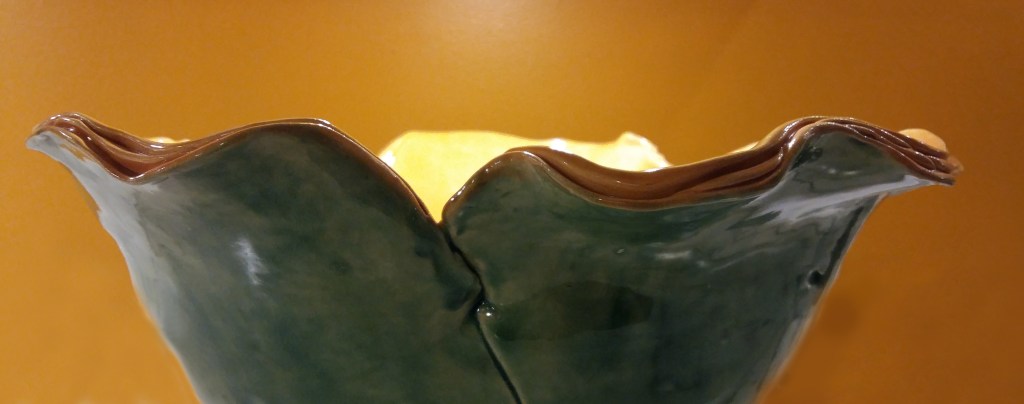
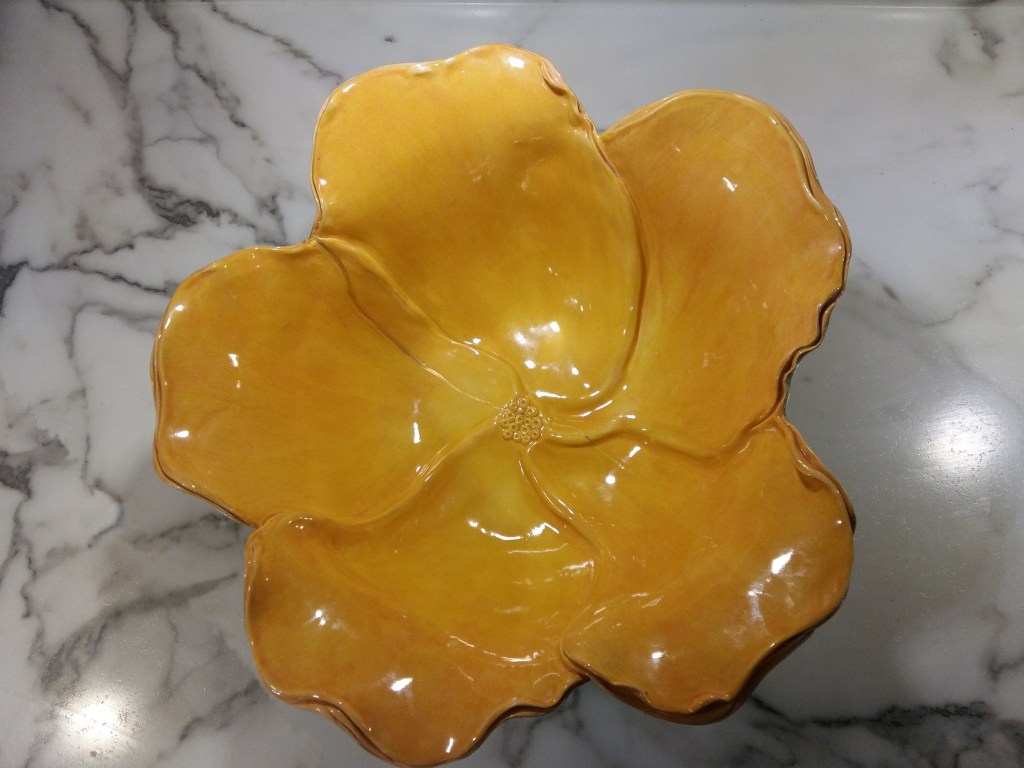
I learned about filling the cracks of pottery with gold in the 1990’s while I was attending the Alberta College of Art and Design. Clay is a vulnerable material and there are so many factors that can contribute to cracking and breakages. During those years I would spend so much time making large, fragile and intricate hand-formed and carved, sculptural vessels. Some of those vessels were large bowls shaped and carved to emulate flowers.
The photos of the one I am sharing here in this post was cracked while being fired and knowing the art of Kintsugi I decided to work with this one and fill the involuntary opening with a vein of ‘gold’ which was a reminder of the light. Being a student at that time the only gold I could repair it with was imitation gold paint which was painted onto a type of grout which I used to fill into the crack. Does that make it less valuable? No, not in my eyes. It’s been many years since I have been able to work with clay and I have very few pieces left from those days and so I do cherish this bowl.
My final thought is let the light shine into your cracks, we all have them and we also possess golden veins of love, compassion and light which is the ‘vein’ or ‘thread’ which connects us to each other. Next time you see the cracks in others pour some golden love and light into them—it does us all good because what we do to others we do to ourselves and what we do to ourselves we do to others since we are all connected.
 heatherdawnfineart